
Ask ten builders how much it costs to build a custom home, and you will probably get ten different answers. That is not a dodge. A custom home is priced around the choices you make, so the honest response is another question: what do you want to build, and where?
Still, you deserve real numbers before you sit down with anyone. This guide breaks down what a custom build actually costs in 2026, where every dollar goes inside that budget, and the two line items that quietly stretch custom projects past their original estimate. By the end, you will know how to read a builder’s number and spot whether it is built to hold.
The honest average for 2026
Nationally, the typical cost to build a custom home in 2026 is around $825,000, with builds ranging from about $160,000 for a small, simple home to $3,500,000 for a large luxury property. In terms of square footage, custom homes generally run $200 to $550 per square foot, and that spread is almost entirely a story of finish level.
Here is a size based view to anchor your planning:
| Home size | Typical custom cost |
| 2,000 sq ft | $400,000 to $1,100,000 |
| 3,000 sq ft | $600,000 to $1,650,000 |
| 4,000 sq ft | $800,000 to $2,200,000 or more |
Those are wide bands on purpose. A 3,000 square foot home with mid-range finishes and a builder’s proven plan sits near the bottom. The same footprint with imported tile, custom cabinetry, and a complex roofline sits near the top. Your job, and a good builder’s job, is to figure out where on that line your home belongs before construction starts.
Where your money actually goes
The most useful thing to understand about a custom home budget is how it breaks down. When you see the categories laid out, the price stops feeling like one scary lump sum and starts looking like a set of decisions you can actually manage.
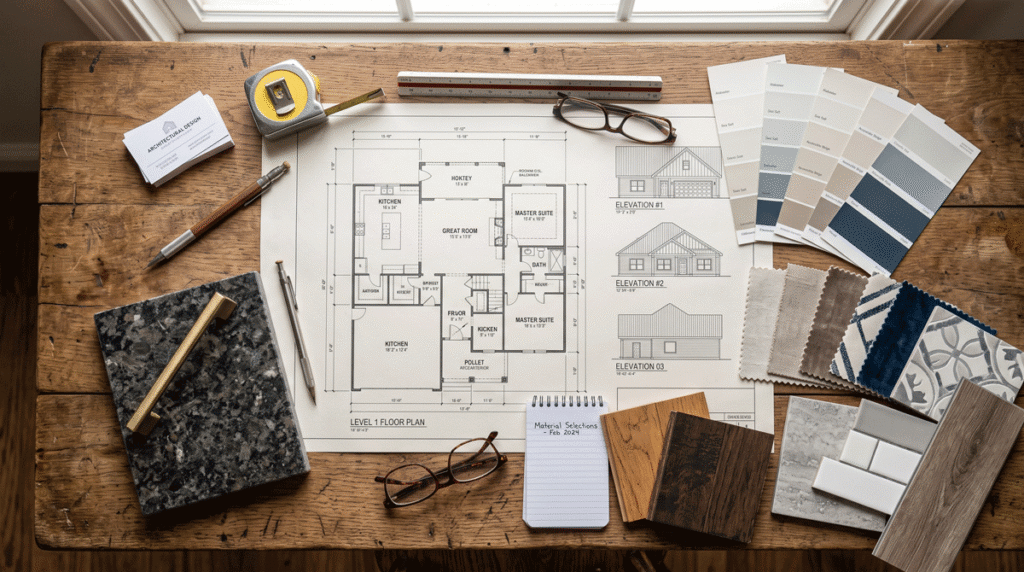
Here is how a typical build divides, with rough dollar figures mapped onto an $825,000 project:
| Category | Share of budget | Roughly, on an $825k build |
| Interior finishes | 22 to 26% | $180,000 to $215,000 |
| Major systems (plumbing, electrical, HVAC) | 17 to 20% | $140,000 to $165,000 |
| Framing | 15 to 18% | $124,000 to $148,000 |
| Exterior finishes | 12 to 15% | $99,000 to $124,000 |
| Foundation | 10 to 12% | $82,000 to $99,000 |
| Site work | 6 to 8% | $50,000 to $66,000 |
| Final steps and landscaping | 5 to 7% | $41,000 to $58,000 |
| Insurance, surveys, and other | 2 to 4% | $16,000 to $33,000 |
Notice which category is the biggest. Interior finishes- the flooring, cabinets, countertops, trim, tile, lighting, and appliances- eat up roughly a quarter of the whole budget. This is the single most important thing to grasp about a custom build. The structure that holds your house up is largely fixed, but the finishes are where your taste meets your wallet. A cabinet package alone can swing a build by tens of thousands of dollars.
For perspective on the bones of the house, on a smaller $350,000 build, the foundation runs about $38,500, framing about $59,500, and interior finishes about $84,000. The proportions hold steady as budgets grow, which is exactly why understanding them helps at any price point.
The costs a custom home carries that a spec home does not.
This is what separates a custom budget from any other kind of home purchase, and it is where many first-time custom clients get surprised. A spec home is built from a proven plan with a set finish package, so many of these costs are already handled. A custom home starts closer to a blank page, and that freedom comes with its own line items:
- Design and plan costs. Bringing your vision to paper runs roughly $10,000 to $60,000 for architectural design, depending on how detailed and original the plan is. Working from a proven plan and modifying it, rather than designing from scratch, is one of the biggest ways to keep this number down.
- Structural engineering. For anything beyond a standard layout, expect about $2,000 to $10,000 to make sure the design is sound.
- Land preparation. Grading, surveys, and soil testing can run from a few hundred dollars on an easy lot up to $20,000 or more on a challenging one.
- Utility connections. Bringing water, sewer or septic, and power to the home averages around $20,400, and a remote lot can push that past $60,000.
- Permits. Usually $1,000 to $4,000 depending on your jurisdiction.
None of these show up in a “price per square foot” headline, yet they are real and unavoidable on a true custom build. A builder who names them for you up front is doing you a favor, even when the total gets less comfortable to look at.
Allowances and change orders: the two words that move your final price
If a custom home ever comes in far above the original quote, one of these two culprits is almost always behind it.
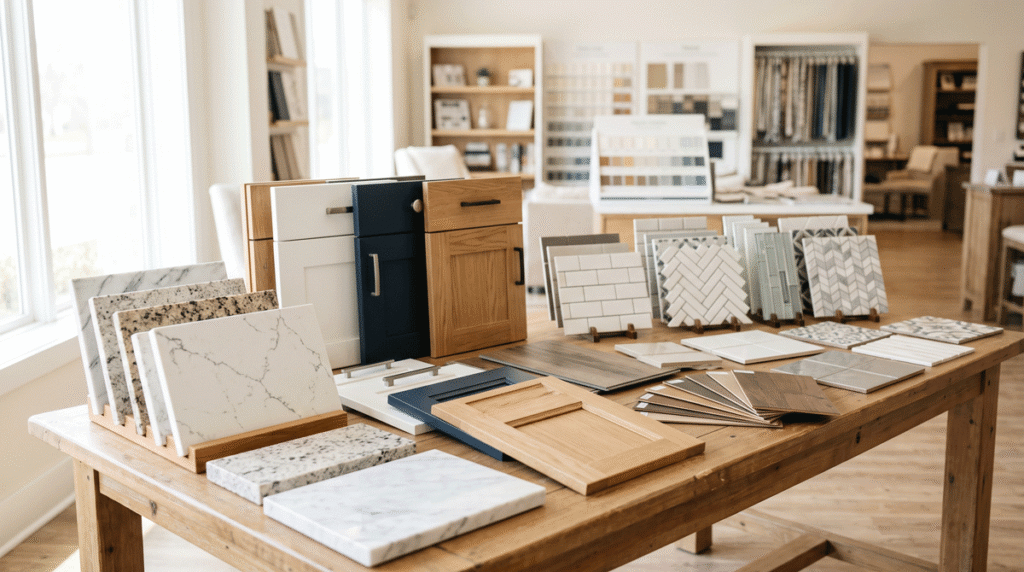
An allowance is a placeholder amount your builder sets for a category you have not fully chosen yet, like flooring or plumbing fixtures. Say your contract allows $12 per square foot for flooring. If you fall in love with a hardwood that costs $18 per square foot, the difference is added to your bill. Allowances are normal and useful, but a budget stuffed with low allowances can look cheap on paper and then climb once you start making real selections. When you compare builders, compare their allowances, not just their bottom lines.
A change order is exactly what it sounds like: a change you request after the plan is set. Moving a wall, adding a window, or upgrading a shower mid-build all trigger change orders, and they almost always cost more than the same choice would have during planning, because work may need to be undone. The fix is not to avoid changes entirely. It is to make as many decisions as possible before the first shovel hits the ground, so changes stay rare.
Understanding these two levers is what turns a nervous buyer into a confident one. You are not at the mercy of a mystery number. You are steering it.
How to lock in a custom home price you can trust
Most custom home stress comes from a single source: the gap between the estimate you were quoted and the invoice you actually pay. Close that gap and the whole experience changes.
The most reliable way to do that is with a fixed-price agreement. Instead of an estimate that drifts with lumber prices and subcontractor availability, your number is locked after you sign. If material costs jump partway through your build, that is the builder’s problem to absorb, not a surprise line on your statement. Pair that with a builder who follows a clear, itemized process and uses realistic allowances, and the guessing disappears.
At Holloway Family Homes, this is how we have built since the 1980s across North Carolina . We lock in your price with a fixed-price agreement, include premium finishes like luxury vinyl plank flooring and quartz or granite countertops as standard rather than budget-stretching upgrades, and offer in-house financing for flexibility. At the same time, you arrange permanent financing after your home is finished. If you already have a plan you love, bring it. If you want to start from one of ours and make it yours, we can do that too.
Frequently asked questions
How much does it cost to build a custom home in 2026?
The national average is around $825,000, with most custom homes running $200 to $550 per square foot. A 2,000-square-foot custom home typically falls between $400,000 and $1,100,000, depending on finishes, land, and design complexity.
What is the most expensive part of building a custom home?
Interior finishes, meaning flooring, cabinets, countertops, trim, and fixtures, are usually the largest single category at roughly 22 to 26 percent of the total budget. It is also the area you control most.
Why did my custom home cost more than the original estimate?
Almost always because of low allowances or change orders. Selections that exceed the placeholder allowance, or changes requested after the plan is finalized, get added to the final price. A fixed price agreement and firm early decisions prevent most of this.
Is a custom home more expensive than a spec home?
Generally yes, because you are paying for design and personalization rather than a proven, ready-made plan. That said, choosing a builder whose finish package already includes quality materials narrows the gap considerably.
Let us build you a real number.
Averages are a starting point, but your custom home deserves a price built around your plan, your lot, and your finishes, not a chart. If you are building in North Carolina, we would love to walk you through the numbers with full transparency. Book a consultation with Holloway Family Homes, and let us give you a fixed price you can plan your life around.
Ready to build on your land?
Let's talk about designing a home that fits your life, not the other way around.
Book a Consultation →